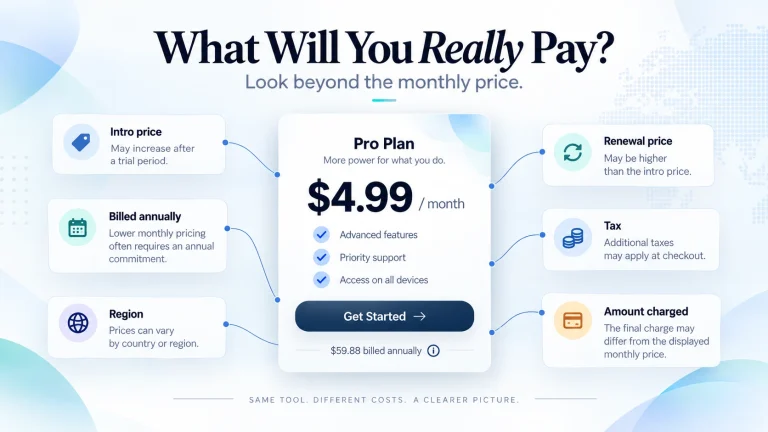
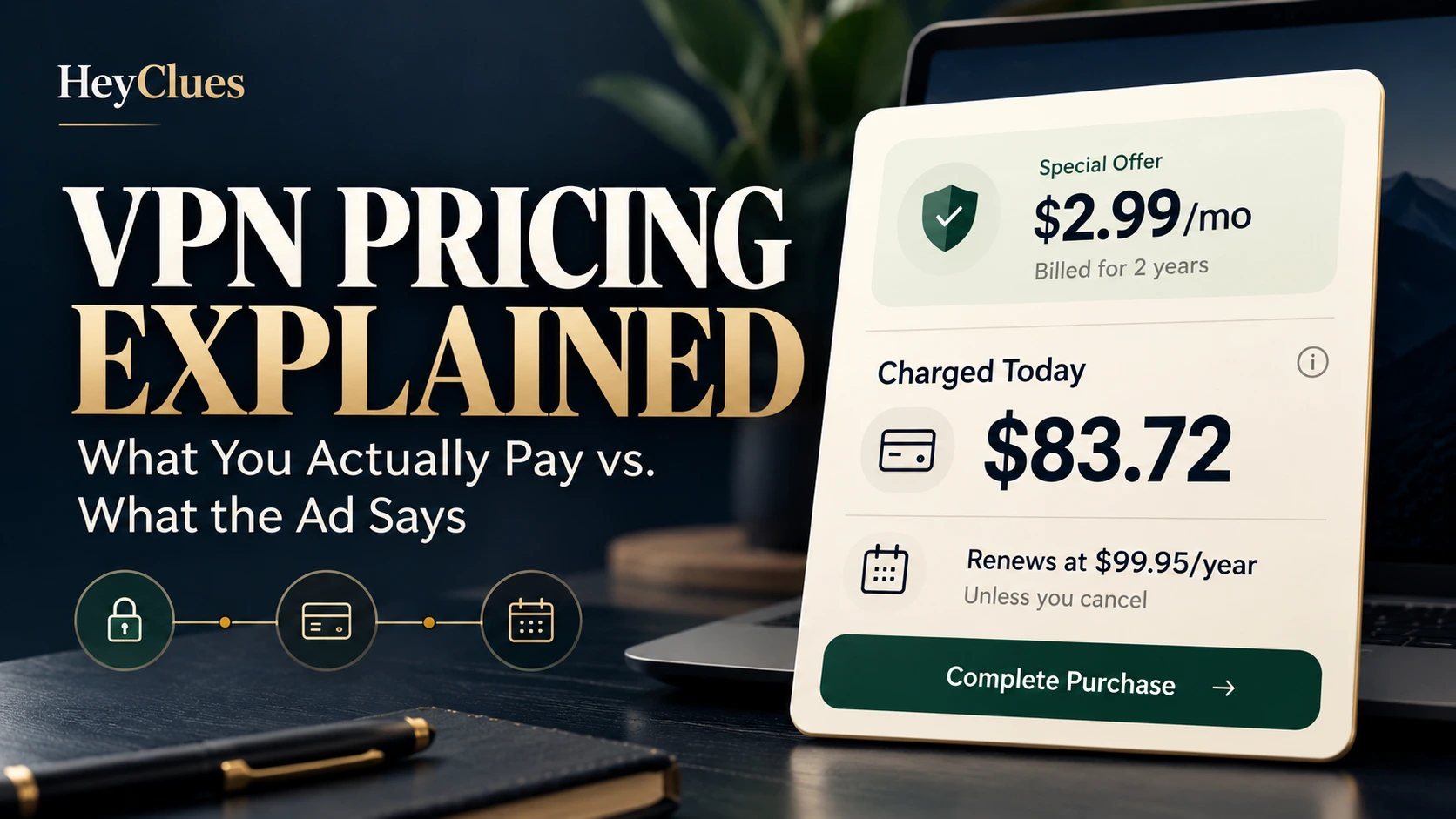
VPN pricing explained: the advertised monthly price can be very different from what you actually pay today.
NordVPN Basic illustrates the pattern: a low monthly equivalent, a larger upfront charge and a different annual renewal. These figures describe different parts of the same subscription. This guide focuses on what you pay now, how long that payment covers, and what happens when the introductory period ends.
For the broader principles behind software introductory offers, billing periods, renewals and regional pricing, see How to Compare Software Subscription Prices: Intro Offers, Renewals, Taxes & Regional Pricing.
A quick example: US$3.49/month vs what you actually pay
HeyClues Quick Price Check — NordVPN Basic
| Field | Value |
|---|---|
| Advertised monthly equivalent | US$3.49/month |
| Actual subscription charge today | US$94.23 |
| Initial term | 24 months + 3 extra months |
| Total initial access | 27 months |
| Current stated renewal | US$139.08 for 12 months |
| Tax | Sales tax may apply |
| Reference pricing | USD |
| Price checked | 27 September 2026 |
US$94.23 ÷ 27 months = US$3.49/month
So the advertised monthly figure is accurate, but the billing is different: US$94.23 — not US$3.49 — is charged upfront.
Before buying a VPN, check the C.L.U.E.S.
C — Charge Today
What amount will actually leave your account when you complete checkout?
Ignore the oversized monthly equivalent for a moment and find the full amount being charged now.
L — Length Covered
How many months does that first payment actually buy?
Do not stop at the plan name. A “two-year” offer may provide 24 months, 27 months or 28 months once extra promotional months are included.
U — Upsells & Add-ons
Are you paying only for the VPN?
Dedicated IP addresses, antivirus software, password managers, identity services and larger security bundles can materially increase the final price.
E — Exit Terms
How do you stop renewal? How do you request a refund? Does cancelling simply stop the next bill, or does it also return money already paid?
The answers can vary by provider, payment method and purchase channel.
S — Subsequent Price
What happens after the introductory period?
Find both the next payment amount and how many months that payment buys.
VPN pricing explained: current examples
Reference market: United States. Prices checked 27 September 2026. USD except Mullvad. Taxes and regional pricing can vary.
| Provider / plan | Advertised rate | Charge today | Initial access | Current renewal |
|---|---|---|---|---|
| NordVPN Basic | US$3.49/mo equivalent | US$94.23 | 27 months | US$139.08/year |
| ExpressVPN Basic | US$2.99/mo equivalent | US$83.72 | 28 months | US$99.95/year |
| Surfshark Starter | US$2.49/mo equivalent | US$67.23 | 27 months | Annual standard non-introductory rate |
| Mullvad | €5/month | Depends on time added | User-selected | Same €5/month base rate |
Surfshark’s official billing policy states that introductory offers renew at the standard non-introductory rate. Because the exact numerical renewal amount is not reliably exposed on the current public pricing page, HeyClues does not insert an assumed figure.
Mullvad takes a very different approach. Its direct price is €5 per month including VAT whether you buy one month, one year or much longer.
Bonus months change the math—and the renewal date
Bonus months extend the initial service period and can lower the advertised monthly equivalent because the upfront charge is spread across more months.
They also delay the first renewal.
For example, a 24-month plan with four extra months provides 28 months of initial access, so the first renewal should occur after month 28—not month 24.
Introductory price and renewal price are two different numbers
NordVPN Basic makes the renewal jump easy to see: US$94.23 covers the initial 27 months, while the current renewal is US$139.08 for 12 months, or US$11.59/month equivalent. The introductory monthly equivalent should not be projected indefinitely.
ExpressVPN Basic follows the same pattern: its current US$83.72 introductory payment covers 28 months, followed by a currently stated US$99.95 annual renewal.
The important point is that the introductory monthly equivalent should not be projected indefinitely.
Be careful with “three-year cost”
VPN subscription periods do not always fit neatly into a 36-month comparison.
NordVPN Basic currently provides 27 months for US$94.23. Paying its US$139.08 annual renewal takes total coverage to 39 months and total cash paid to US$233.31.
So calling US$233.31 simply a “three-year cost” would be imprecise—the payment buys three additional months beyond that point.
Compare the periods customers actually have to purchase rather than silently prorating a full renewal.
“69% off” or “80% off”: discount compared with what?
A large percentage can look more dramatic than the underlying payment.
But different providers can calculate discount percentages against different reference prices.
NordVPN currently labels Basic “Save 69%” and describes its calculation using introductory pricing compared with its renewal pricing.
ExpressVPN currently labels Basic “Save 80%” and says its displayed discounts are reductions from the current monthly service price for the selected tier.
Those are not the same reference point.
So comparing 69% off with 80% off does not necessarily tell you which plan costs less or offers better value.
The HeyClues rule is:
Ask: “Discount compared with what?” Then compare the amount due today, months covered, renewal amount and renewal term.
What should you make of countdown timers?
Countdown timers and “limited-time” banners create urgency, but a clock alone does not prove the price will disappear when it reaches zero.
Do not use the timer as evidence of value. Judge the actual payment, term length and renewal conditions instead.
Refunds and cancellation are not the same thing
Canceling a subscription normally stops future billing; it does not automatically return money already paid.
A money-back guarantee is different: you usually pay first and must request an eligible refund within the stated window.
NordVPN currently offers a 30-day money-back guarantee on a new initial subscription. Renewed subscription periods are not covered under that guarantee unless applicable law requires otherwise.
Surfshark similarly gives eligible first purchases a 30-day refund period, while renewed subscriptions and certain add-ons or purchase channels have exclusions.
ExpressVPN provides eligible first-time direct customers 30 days to request a refund. Purchases billed through Apple or Google Play use the relevant store’s refund process instead.
Proton also separates cancellation from refund requests. Cancelling stops future renewals while paid features remain active until the current billing cycle expires; eligible website customers must separately request a refund.
Considering Proton specifically? See our Proton VPN Free vs Plus review for plan limits, pricing and which users actually need Plus.
Auto-renewal: check the second bill before paying the first
Long-term VPN plans can make the next payment easy to forget because renewal may be more than two years away.
Before buying, note the renewal date, renewal amount, renewal term and how to turn renewal off.
NordVPN, Surfshark and ExpressVPN use automatic renewal on paid subscriptions. Mullvad’s direct model is different: users manually add account time instead of moving from a discounted introductory term to a higher automatic renewal.
Check the second bill before you pay the first one.
Add-ons and bundles can change the real VPN cost
VPN companies increasingly sell additional security and privacy products.
That means two plans with different prices may not contain the same things.
A dedicated IP is one common example.
CyberGhost currently lists its dedicated IP as a separate recurring add-on. It also offers a Windows Security Suite as an additional recurring purchase.
ExpressVPN offers dedicated IP separately on some plans, while its higher tiers include additional security products beyond the core VPN.
NordVPN’s higher tiers also include products beyond its Basic VPN plan, such as password management, security tools and cloud storage.
Compare like with like: a VPN-only plan and a larger security bundle are not equivalent.
Monthly vs long-term: neither is automatically smarter
Long-term plans can make sense when you expect to use the VPN for the full term, can afford the upfront payment and understand the renewal conditions.
Monthly billing costs more per month but can make more sense for short-term use or when flexibility matters.
So “lower monthly equivalent” and “better choice for me” are not automatically the same thing.
Regional pricing, currency and taxes
A US-dollar screenshot should not be treated as a worldwide VPN price.
Providers can vary billing currency, regional pricing and tax treatment by market. Surfshark supports currencies including GBP in the UK, CAD in Canada and AUD in Australia. Proton also supports several local billing currencies, while Mullvad’s direct price is €5 per month including VAT.
Sales tax, VAT or GST may also be added depending on the provider and billing location.
The figure that matters is the final checkout total in your own billing currency.
The bottom line
A low VPN monthly price can be legitimate while still requiring a much larger payment upfront.
The key is to separate the advertised monthly equivalent from the amount charged today, then check what happens when the introductory term ends.
Long-term plans can offer lower effective prices, while monthly plans provide more flexibility. Neither is automatically the better choice.
Before paying, make sure you understand the full first payment, the length of service it covers, and the next renewal charge.
That gives you a much clearer picture of the real cost than the smallest number in the advertisement.